Inverness
Every once in a while you encounter a bad service experience – this exemplar touches on one such encounter. With aggregate products, such a trip to a city, a bad service encounter can be shrugged off, however, sometimes it is so bad that it impacts on a customer’s overall evaluation and can even impact on previously held attitudes. Doing things right first time and dealing with complaints are quite different.
It was the worst service experience of the entire trip by a long way. The ladies on reception tried to renegotiate the cost of our room by an additional fifty pounds. This was unbelievable, as this would mean that it was seventy five pounds above the current online rate that they were offering. We knew we were being ripped-off with original charge. The reception staff kept going to consult with the manager and kept coming back with ‘the manager said this … the manager said that’. I think the manager was overly focused on his asset revenue generating efficiency.
Bizarrely, when we were checking-in [and waiting for the manager’s ultimate pontification] the receptionist called security – a person had entered the hotel and used the toilet – when confronted by the security guard it turned out that the person was a guest who had left his bags for safe keeping whilst he explored the town and waited for his train.
When, I reflected on our Inverness hotel experience, I attributed blame partly as a consequence of our earlier indecision and that I booked the rooms in a hurry and did not look beyond the overall rating. Nevertheless, I also learned a lesson from this hotel – the historical data of the online reviews and the recent reviews are not always congruent. I analysed 100 reviews from each of the two leading online bookings sites and found that recent history would suggest that this was a hotel that has lost its way. In fact, recent comments suggest that the management had no concept of what it means to be part of the hospitality industry. Also, when I sorted by lowest scores to highest scores, it revealed that our experience was not unique.
Sure, there could be reasons for the deviation between historical data and recent data – it could be that in the height of the tourism season they are a little overwhelmed, however, in a cyclic business, such as tourism, this is not an excuse – this is poor management. A number of online comments identified a failure to meet what can only be described a core product failure; for example, moldy bathrooms, smelly rooms, noise from the next door rooms, and lack of civility. Other online comments identified expected product failures; for example advertising onsite parking when in reality there was only a few bays, advertising free wifi and then having very limited guest access. Interestingly, when I asked where the free hotel parking was the staff said that ‘in reality there was no parking because the managers occupied them’, however, there was in a public car park down the street. One, disillusioned, staff member stated that the only way to get free parking was ‘to wait till the manager leaves and grab his spot’. He went on to state that ‘the hotel computer system and the management were so antiquated that they ran on gas’. When checking out of the hotel an employee asked me if I had enjoyed my stay, this was like a routine question. I said ‘my room was nothing like what was displayed online’ she stated ‘well the only way to get a good room here – is to complain’. It is clear from staff comments that the staff are demonstrating signs of frustration, from other comments I could cautiously speculate that they may be bullied by an unprofessional and floundering manager. Moreover, I speculate that as soon as a better job, in a better hotel becomes available – the best staff will leave.
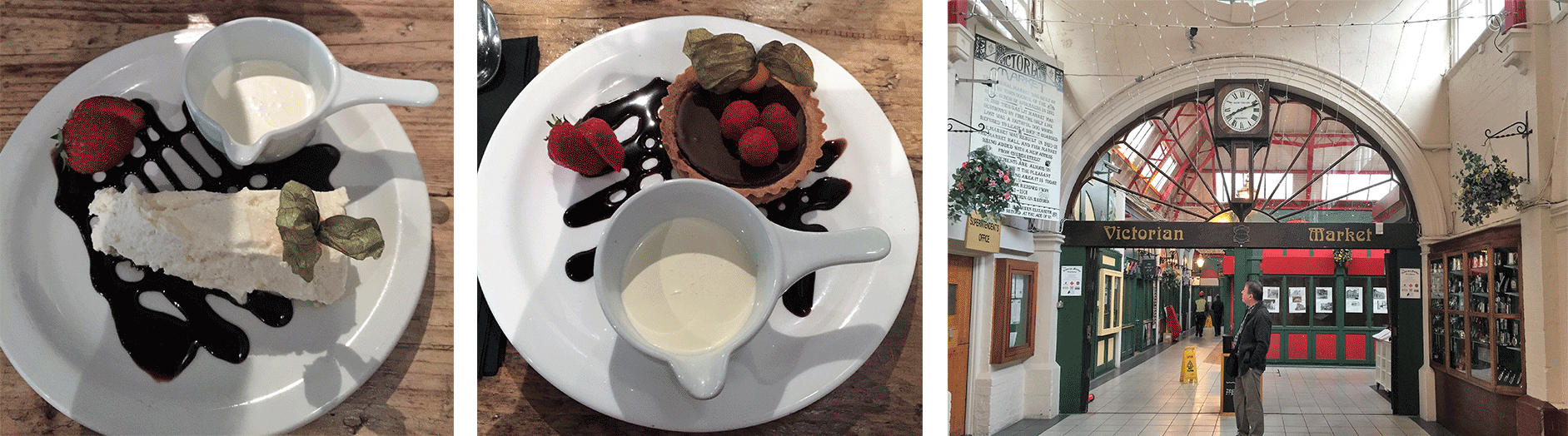
Inverness was not all bad. We had a lovely coffee and cake at a nearby coffee shop. We were walking past a coffee shop when it started to bucket down; we asked if there was a spare table and the waitperson said ‘come on in out of the weather – I will find you a table … oh and by the way I would recommend the cheesecake it is delicious’. Over the next twenty minutes, when not serving other customers, our chatty waitperson revealed she was soon to have her 18th birthday, was hoping to have a little party, if her parents agreed, had recently finished high school and she was hoping to get into university to study physiotherapy. We found this waitperson, refreshing, and an absolute tonic and she was right – the cheesecake was superb. With our faith in the quality of Scottish service restored we tried to forget the hotel with its ‘foosty pidgeon shit smell, sloping floors, and angry staff’.
Tasks
Task: As we discovered during the circle of satisfaction module – staff are so important; staff are either a dominant or a determinant product component. Staff can be part of the competitive advantage or disadvantage. Consider this exemplar [both good and bad encounters] relative to the service profit chain.
Task: Consider a hotel where the staff are so scared of their manager that they need to repeatedly consult with the manager during something as simple as the check-in process.
Task: Regularly over a 24 months period I visited the online reviews and started to notice an improvement – Consider the influence of online reviews on a hotel manager’s career, however, I also noticed that many of the comments referred to a ‘great deal’ and ask you to consider the influence of discounting on customer expectations and evaluations. Also, consider the financial impact of discounting in an effort to attract guests.
Task: Consider the complexity of attracting guests and gaining word of mouth recommendations after a period of management neglect.